


Welcome to Seghill, a Northumberland village with a proud past, a strong spine, and a heartbeat that still echoes the rhythm of its coal-stained history.
Nestled between Cramlington and Seaton Delaval, Seghill may seem like a quiet spot today, but don’t be fooled: this village was once on the frontline of border tensions, industrial booms, and working-class rebellion. Every brick, every field, and every lane here has a story to tell.

From Medieval Fields to Fortified Towers
Seghill’s story begins way back in the 12th century, when King Henry I granted land here to Tynemouth Priory. Over time, the land passed through the hands of noble families like the Selbys, Delavals, and Mitfords, names that echo through Northumbrian history.
In the 15th century, as border skirmishes with Scotland raged on, Seghill saw the construction of one of the largest pele towers in the region. Built for defence, this medieval stone fortress was later modified and mostly demolished in the 1800s. Yet, a part of its vaulted basement still survives beneath the site of the old Blake Arms pub, a hidden reminder of Seghill’s fortified past.

Faith, Foundations, and Community Spirit
Religion and community have always walked hand-in-hand here. Holy Trinity Church, completed in 1848, became a focal point for villagers’ spiritual and social lives. Not to be outdone, the Primitive Methodists left their mark with a chapel built in 1901 after years of holding meetings in homes and barns.
These weren’t just places of worship, they were vital hubs for education, activism, and solidarity. They helped shape the strong community ties that define Seghill to this day.

The Coal That Built Us
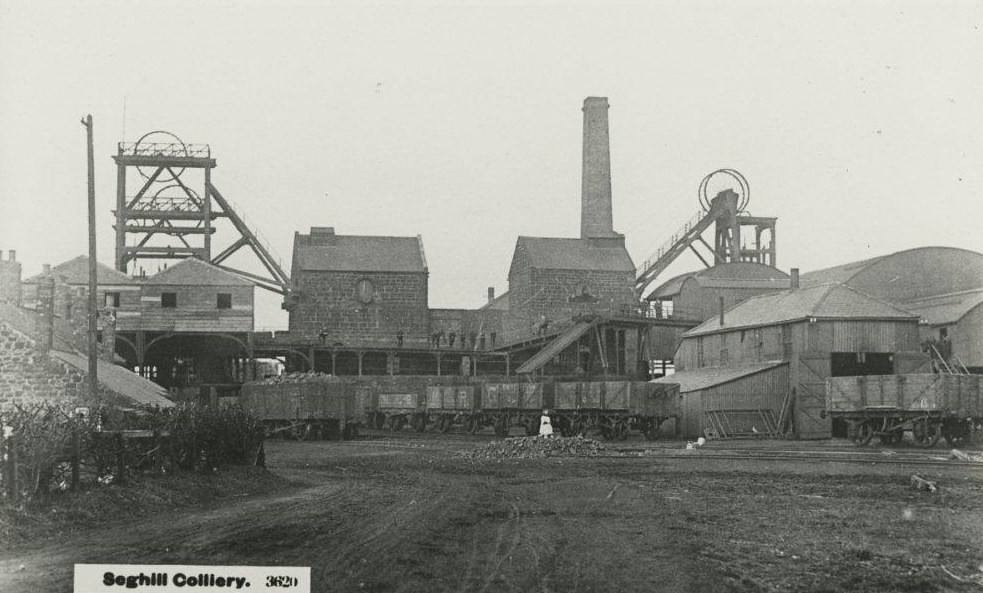
The biggest shift came in 1824 with the opening of Seghill Colliery. Coal put Seghill on the map, and into the spotlight.
At its peak, the colliery employed over a thousand men and produced hundreds of thousands of tons of coal a year. But with the coal came conflict. In 1844, striking miners were evicted from their homes and replaced with non-union “blackleg” workers. The bitterness ran deep enough to earn Seghill a verse in the notorious protest folk song Blackleg Miner, which still sends chills through any pit community.
Mining gave Seghill its working-class identity, but it also demanded resilience. When the colliery finally closed in 1962, the village didn’t crumble, it adapted.

Trains, Tracks, and Turning Points
In 1841, the Blyth & Tyne Railway connected Seghill to the world. A station was built and served the village for over a century. It closed to passengers in 1964, and while freight still rolls through, locals today rely on nearby Seaton Delaval for rail travel.
There’s been talk of reopening the station, an echo of the old infrastructure that once pumped life into the village’s veins.
Sport, Spirit, and Social Glue
Even during hardship, Seghill’s community never missed a beat. In 1921, during a miners’ stoppage, locals started Seghill Rugby and Football Clubs, teams that’s still competing a century later.
The Seghill Miners’ Gala, first held in 1911, remains a proud tradition. After a break during the pandemic, it’s back in full swing, celebrating the village’s heritage with parades, music, and unmistakable pride.
From the welfare field to the scout hall, these aren’t just activities, they’re Seghill’s soul.

The Village Today
Now part of the wider Seaton Valley parish, Seghill has evolved without losing its roots. Its population sits around 3,000, and while the pits are long gone, the village remains fiercely proud of its mining past and the communities that shaped it.
It’s a place where stories live in the stonework, and where local identity is more than just nostalgia, it’s active, visible, and growing.
 Donate Today